
Interview
Guest Insight: Why Predictability Breaks Down, and What Leaders Often Overlook – Dan Palmer
Why predictability breaks down — and what leaders often overlook
A real-world case demonstrating how digital tools improve decision-making, collaboration, and project delivery in complex environments.
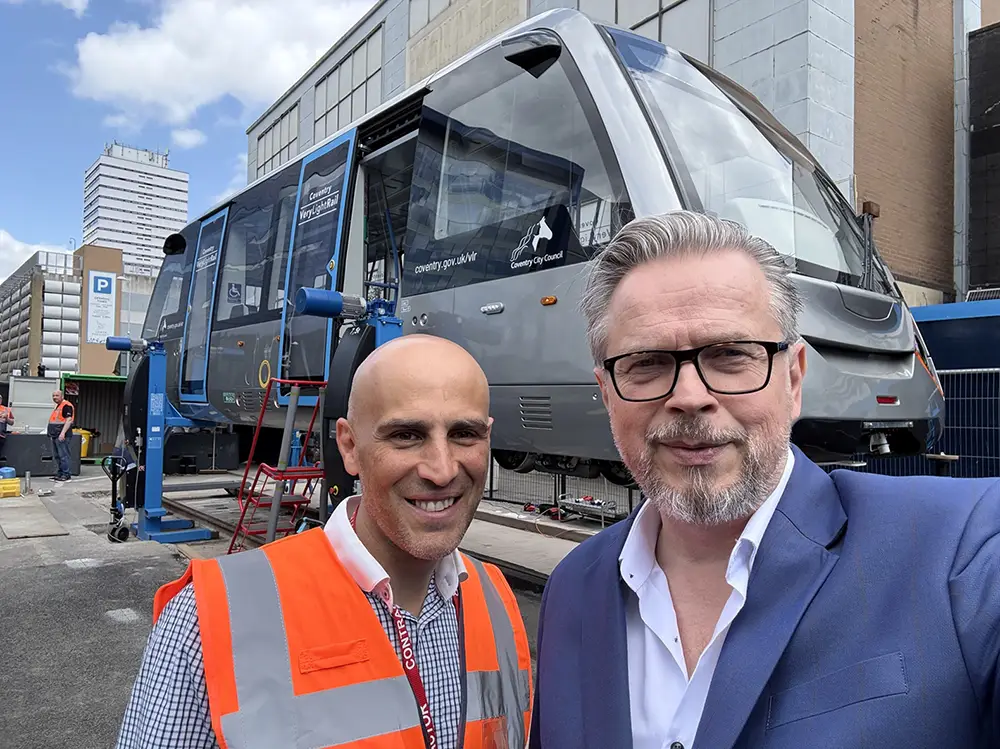
I’m Christopher Micallef, the Track Programmes Lead for Coventry VLR at Coventry City Council in the UK. I’ve been working on the project since 2018, taking it from a blank sheet of paper to a functioning rail system. The objective from the start was to create a new type of track infrastructure that could deliver a step change in cost reduction when building in complex urban environments.
We recently completed our fourth pilot installation – the most significant one yet – because it was built in a live, urban environment. That step brought with it many challenges, but it was also an opportunity to prove the value of the track system and how it performs in real-world conditions.
This certainly wasn’t easy. However, thanks to the groundwork laid by the previous pilot phases and, critically, our investment in digital construction platforms, we were able to deliver the project on time and on budget. These tools proved essential in responding to the inevitable changes that occur on any construction project. They enabled us to make quick, informed decisions that kept the work moving without sacrificing quality or incurring major delays or cost overruns.
There were definitely moments of uncertainty. One example stands out: during construction, we discovered a flaw in the vertical alignment of the track, stemming from decisions made early in the design process. If we had blindly followed the drawings, we would have encountered serious issues requiring major rework. But because of our digital platform, we caught the problem early, remeasured, redesigned, and adjusted quickly without halting the work. That experience underscored the importance of having the right tools in place.
I had been advocating for the use of digital tools in this project from the beginning, and while not everything went smoothly, they proved to be absolutely critical. We also learned a lot about how to use these systems more effectively in future phases. For example, we didn’t fully take advantage of their ability to capture and record quality metrics on site, but we plan to implement that more comprehensively next time.
The biggest advantage of digital tools, from my perspective, was visibility. They gave us the ability to make better decisions, faster. Instead of relying on static 2D drawings, we had a live 3D model that could be interrogated from multiple angles. It allowed us to zoom into specific details, extract needed 2D data when necessary, and fully understand the implications of what we were seeing. In a dynamic construction site, that’s invaluable.
Visualisation was another key benefit. We integrated drone imagery and orthomosaics into our models and overlaid them with design data. This was particularly useful for stakeholder engagement. I could take a screenshot, annotate it, and share it with a utility provider or another stakeholder to highlight a specific issue or decision point. It meant I didn’t need advanced CAD skills – just the platform itself.
Driving this kind of change requires someone to champion it. Change doesn’t happen passively. These tools require a bit of upfront investment – time, effort, and mindset. It’s often easier to stick with the status quo, but the payoff for overcoming that friction is substantial. In my case, having seen similar challenges repeatedly across projects, I knew digital tools could solve long-standing pain points. Importantly, they democratise access to data on site. People aren’t dependent on one survey engineer; they can access the same information and contribute more actively.
In one instance, we had a mismatch between the design and the actual site conditions. Using traditional methods, we would have had to hire a third-party surveying company, commission a new survey, compare it manually, and wait days – if not weeks – for results. But with our digital platform, we uploaded new survey data, compared it directly to the model, and immediately understood whether the issue was within acceptable limits or needed intervention. That alone saved us several days.
Perhaps the most lasting benefit of this first digital phase is cultural. Now, most people on the team have seen the value of these tools firsthand. That means we start the next phase with buy-in already in place. We don’t need to convince people anymore. They’re on board.
Going forward, we’ll push things even further. We’re planning automatic linking between survey instruments and the model, real-time quality assurance reporting directly from the field, and new templates that make it easier for everyone to use the system intuitively. We won’t be relying on manual uploads or post-site reporting anymore.
My advice to other cities or organisations considering a digital leap is: start small. Don’t roll out these tools on your largest, most high-profile project. Pick something manageable, learn what works, and build from there. If you try to do too much too soon, you risk backlash that can delay adoption for years. But if you scale thoughtfully, the benefits speak for themselves.
Why predictability breaks down — and what leaders often overlook

An expert perspective on why successful digital transformation depends on leadership, processes, and shared understanding.
Digital transformation does not start with technology. It starts with people.