At DIMEA, we believe that every successful transformation begins with understanding. In this guest contribution, Ishara Ranasinghe shares a personal story of how digital change unfolds in practice – through experience, learning and leadership, not through tools alone. His reflections highlight a principle we see in every assessment: technology succeeds only when people share a common purpose, clear expectations and a path they can follow together.
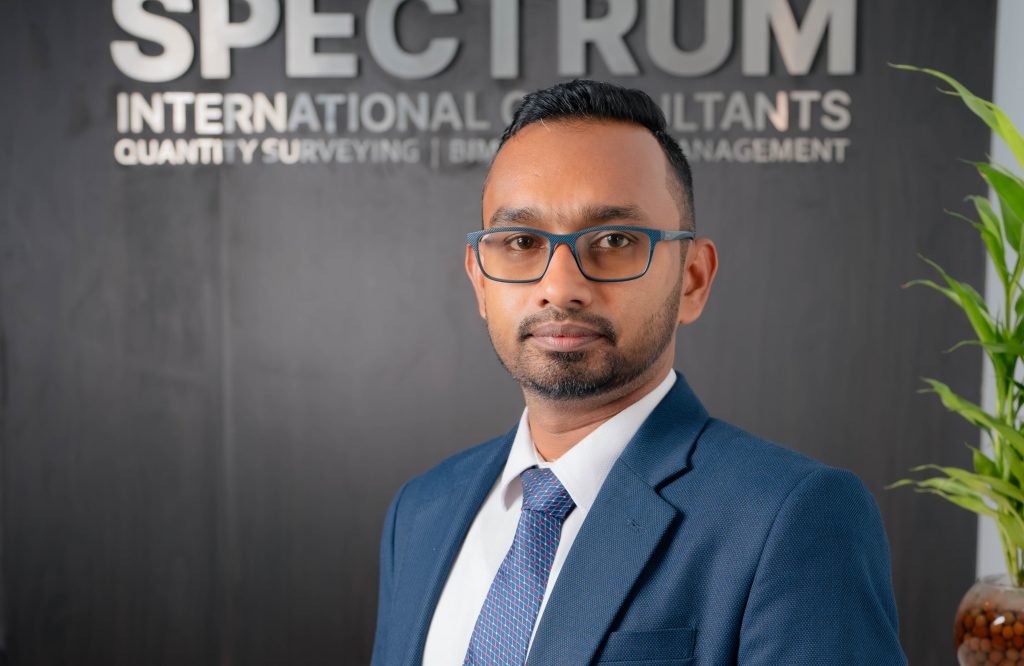
Expert Introduction
Ishara Ranasinghe is a Director – BIM at Spectrum International Consultants with an international career spanning Sri Lanka and the Middle East. His expertise sits at the intersection of digital construction, process development, and leadership.
Alongside his industry role, he is an active lecturer and trainer, working closely with universities and emerging professionals. Ishara is passionate about translating BIM from a technical concept into a practical, value-driven way of working – particularly in organisations and markets where digital transformation is still developing.
Learning BIM the hard way – from tools to leadership
I did not start my career with a vision of digital transformation or BIM leadership. I started it with frustration.
As a quantity surveyor working in the Middle East, much of my time was spent on repetitive manual work – measuring quantities from CAD drawings, drawing polylines and transferring numbers into Excel sheets. It was slow, inefficient and exhausting. I was not looking for digitalisation as an idea. I was simply looking for a smarter way to work.
That search led me to Revit and automated quantity take-offs. Tasks that once took hours could suddenly be completed in minutes. At that point, I believed I had found BIM. Like many others, I confused the software with the methodology.
When tools come before understanding
Our first BIM-related projects followed quickly. We knew how to use the tools, so we assumed we understood BIM. We priced the work cheaply, without fully grasping the scope, responsibility or value of what we were offering. In reality, we were delivering models, not changing the way projects worked.
Those projects were not failures, but they were incomplete. They taught me a critical lesson: BIM is not a tool you add to an existing workflow. When used that way, it becomes an extra burden rather than a benefit.
As project complexity and responsibility increased, it became clear that BIM’s real value does not lie in models, but in how people collaborate, make decisions and manage
information. That was the moment when technology stopped being the main challenge – and leadership started to matter.
Teaching forces clarity
A turning point in my development came through teaching. As a lecturer and trainer, I repeatedly faced the same questions from students and early-career professionals: Where do we start? Which software should we buy? How fast will this pay back?
Answering these questions forced me to simplify my own thinking. Over time, one principle became clear:
Process must come before software.
When organisations invest in tools before defining workflows, roles and responsibilities, BIM feels like extra work. When processes are clear and people are trained properly, technology becomes an enabler rather than an obstacle.
Teaching also revealed that individuals often learn faster than organisations. Young professionals adapt quickly, while companies struggle because change challenges established habits, structures and leadership mindsets.
Where to start – advice for individuals entering BIM
One of the most common questions I hear is simple but difficult: How do I actually start?
My advice is usually less technical than expected. Do not start by buying software or trying to learn every tool available. Tools change quickly and, without context, only create confusion. Instead, focus on understanding how information flows through a project – who makes decisions, when they are made and why they matter.
Invest time in learning processes before mastering software. Understand coordination, information structure and workflow dependencies. With that foundation in place, tools become easier to learn and far more meaningful to use.
Most importantly, be patient. BIM competence does not come from a single course or project. It develops gradually through doing, reflecting and taking responsibility. That mindset matters more than any individual certification.
BIM as a leadership challenge
In my current role as Director – BIM, I spend far less time discussing software and far more time discussing value. The biggest barrier to BIM adoption is rarely technical competence. It is the inability to recognise value that does not appear as direct revenue.
Digital construction creates value through savings – fewer errors, less rework, better predictability and reduced risk. These benefits are real, but they do not always fit neatly into traditional ROI models. When leadership focuses only on immediate financial returns, digitalisation appears costly and unnecessary.
This is why BIM adoption often stalls. Not because teams cannot deliver, but because leadership does not yet speak the same language as digital workflows.
Sri Lanka as a learning environment – and a shared responsibility
In Sri Lanka, BIM adoption is still at an early stage. Challenges remain: limited resources, lack of structured demand and ongoing brain drain. At the same time, there is strong interest, rapid learning and growing international relevance.
Much of the BIM expertise developed by Sri Lankan professionals is now delivered internationally. Knowledge moves, even when local markets evolve slowly. Digital construction has become a global language.
This is also why, in February, we are organising a seminar focused on digitalisation in the construction sector in Sri Lanka. One of its key objectives is to create an open platform for discussion – not about tools, but about what Sri Lanka actually needs and how the industry can move forward together.
The intention is to bring different perspectives into the same conversation: asset owners, contractors, individual professionals, financiers, insurers, educators and technology specialists. Digital transformation cannot be driven by one group alone. Progress requires shared understanding, trust and collaboration across the entire value chain.
For me, this seminar is a natural continuation of the same learning journey described here – moving from individual experience to collective dialogue, and from isolated initiatives to a more coordinated way forward.
Looking forward
My path into BIM was not planned. It evolved through mistakes, learning, teaching and growing responsibility. That is why I believe digital construction should not be approached as a technology project, but as an organisational learning process.
If we want BIM to succeed, we must stop asking only what software to use – and start asking how we lead change.
If you are interested in participating in the seminar or contributing to the discussion, you are very welcome to get in touch directly.
You can contact me at ishararanasinghe@gmail.com / +94 77 364 8348.
DIMEA closing note
Ishara’s journey shows that digital transformation rarely follows a linear plan. It evolves through experience, reflection and shared learning. Progress begins when individuals are
given space to learn, when organisations are willing to question their assumptions, and when leadership accepts that change cannot be delegated to tools.
At DIMEA, we see the same pattern across markets and roles. Sustainable transformation emerges when people understand why change matters, how it affects their daily work, and how they can move forward together – step by step, with purpose and clarity.
Try. Measure. Learn. Scale.

Guest Insight: Why Predictability Breaks Down, and What Leaders Often Overlook – Dan Palmer
Why predictability breaks down — and what leaders often overlook DIMEA INTRODUCTION Across infrastructure and complex delivery environments, the same…

You Can Price Risk. You Cannot Price Uncertainty.
Most decision makers in infrastructure finance do not refuse risk. They refuse not knowing what they are really looking at.…
Is Sri Lanka Late in Digitalisation? That’s a Wrong Question.
Pasi Joensuu – Founder & CEO at DIMEA Global Is Sri Lanka late in digitalisation? It’s a question I heard…

What digital transformation really requires – Expert view: Ishara Ranasinghe
At DIMEA, we believe that every successful transformation begins with understanding. In this guest contribution, Ishara Ranasinghe shares a personal…

How Digitalisation Can Finally Deliver the Results We Expected
After years of investment in tools and platforms, many organisations are still asking the same question. Why have we not…

Why Digitalisation Has Not Delivered Efficiency or Predictability in Infrastructure, Energy, and Utilities
By Pasi Joensuu For more than twenty years we have repeated a simple belief: If we buy better tools, our…

Guest Insight: Digital Transformation Starts With People – Scott Yoo, Autodesk
Digital transformation does not start with technology. It starts with people At DIMEA, we believe that every successful transformation begins…

The Triangle™ – A Clear Lens for Understanding Digital Project Friction
The Triangle™ – A Clear Lens for Understanding Digital Project Friction In infrastructure organisations, digital delivery challenges seldom come from…

The Role of a Leader in the Age of Digitalisation
Leadership has never been about perfection. It’s about direction, trust, and courage. Read more!

Digitalisation from Paper to Practice
Digitalisation from Paper to Practice There’s a lot of talk about digitalisation in infrastructure. But what does it actually mean…